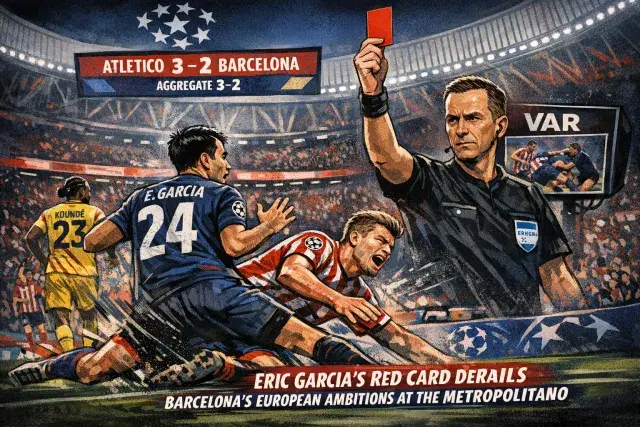
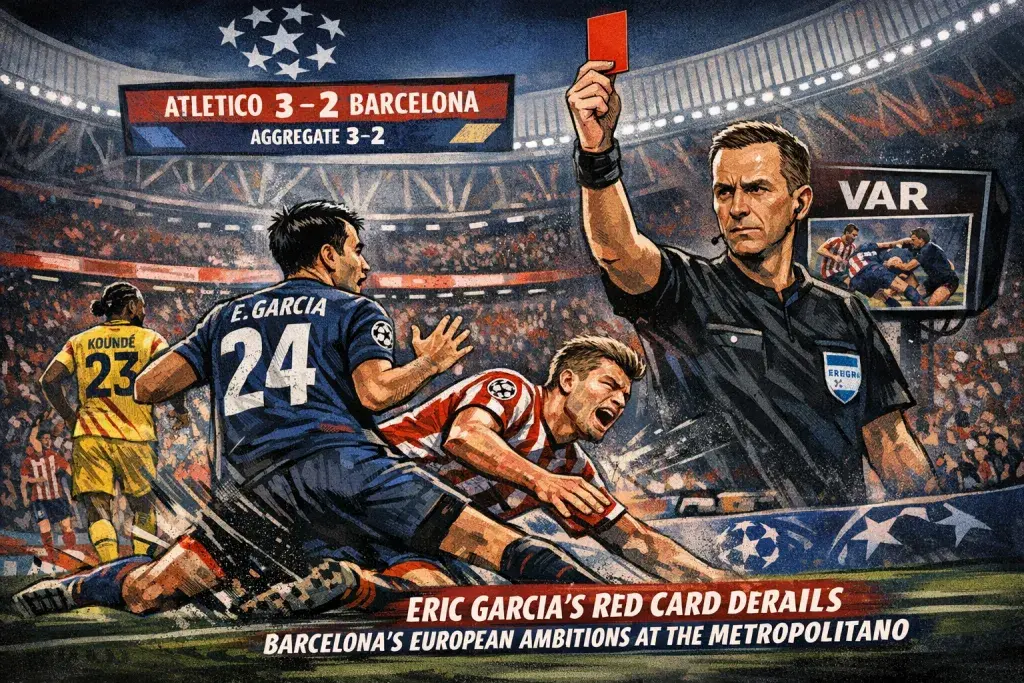
A VAR-assisted dismissal in the 79th minute ended Barcelona's hopes of advancing in the Champions League quarter-final second leg, as referee Clement Turpin sent off centre-back Eric Garcia for denying a clear goalscoring opportunity — leaving the Catalan side with ten men and an insurmountable deficit at the Metropolitano. Atletico Madrid progressed on a 3-2 aggregate, booking their place in the next round. The decision, confirmed only after a prolonged VAR review, immediately ignited fierce debate about the consistency and transparency of officiating at the highest level of European football.
The Moment That Decided Everything
Garcia was adjudicated to have fouled Alexander Sorloth as the Norwegian forward ran in behind the defensive line. The controversy centred on two distinct questions: whether Sorloth was in an offside position before the contact occurred, and whether Jules Koundé, positioned nearby, invalidated the "last defender" determination. Turpin's officials resolved both in Atletico's favour following the review.
Spanish refereeing analyst Iturralde González, speaking on national television, offered a direct reading of the protocol: "They have to check if it is offside and if it is not, they have to check if it is a clear goalscoring opportunity... If it is not offside, I think it is more red than yellow." His framing reflects the established UEFA framework — once offside is excluded, the presence of a covering defender is the critical variable. If that variable is judged insufficient, dismissal is the mandated outcome regardless of the emotional or tactical context surrounding it.
What makes this particularly difficult for Barcelona's supporters is the near-identical sequence that unfolded in the first leg, when Pau Cubarsí was dismissed in the 42nd minute for a professional foul, a red card that directly enabled Julián Álvarez to convert the resulting set piece. Atletico won that encounter 2-0. Two legs, two red cards against the same club, both involving the "last defender" rule — the statistical improbability of that pattern will fuel the conversation long after the final whistle.
A Performance That Deserved Better
Prior to the dismissal, Barcelona had produced one of their most compelling performances of the European campaign. Lamine Yamal capitalised on a Clement Lenglet error to open the scoring inside four minutes. Ferran Torres followed with a precise left-footed finish in the 24th minute, restoring aggregate parity at 2-2 and putting genuine pressure on the hosts.
Atletico responded with characteristic efficiency. Marcos Llorente's creative contribution set up Ademola Lookman to restore the hosts' aggregate advantage, shifting the balance to 3-2. That goal, coming before the red card, was the decisive blow — but the dismissal removed any realistic possibility of a response.
The cruelty of Barcelona's night lies in the contrast between their collective effort and the outcome. They controlled extended periods of the contest, created the clearest early chances, and demonstrated the kind of organised intensity that had been absent in certain previous European outings this season. The red card did not merely reduce them numerically — it erased all tactical flexibility at precisely the moment when the tie was still theoretically within reach.
What VAR Controversy Reveals About Modern Officiating
The Garcia dismissal returns attention to a structural tension that VAR has not resolved: the technology removes obvious errors but introduces a new category of grievance — decisions that are technically defensible yet feel disproportionate to the human context of the incident. The "last defender" determination, in particular, requires officials to assess spatial geometry, intent, and proximity within seconds, then defend that judgment against frame-by-frame public scrutiny.
UEFA has not publicly altered its guidance on the "last defender" protocol, and the rule itself is clear in its written form. What remains contested is its application in ambiguous cases — specifically, when a second defender is present but deemed insufficiently positioned to constitute genuine cover. The Garcia incident fell precisely into that contested space, which is why the review was prolonged and why the reaction was immediate and intense.
Broader patterns in European officiating suggest that VAR has increased the overall accuracy of red card decisions while simultaneously making each one more visible, more analysed, and more controversial. Decisions that would previously have passed without technological scrutiny are now dissected at multiple angles, creating a paradox: more correct calls, and yet more sustained argument about each of them.
The Road Ahead for Both Clubs
Atletico Madrid will face either Arsenal or Sporting CP in the next round, carrying the confidence of a well-managed two-legged elimination and the experience of having navigated pressure from one of Europe's most in-form attacking units.
Barcelona return to domestic competition nine points clear at the summit of La Liga, with the title widely expected to follow. Their European exit, however, will sting — not because the aggregate result was undeserved across two full contests, but because the manner of elimination, bookended by two red cards in two legs, offers a narrative of misfortune that is difficult to argue against entirely. Rebuilding belief for a potential final run-in will be straightforward given the points cushion. Processing the sense that European elimination arrived partly through circumstances outside their control will take considerably longer.